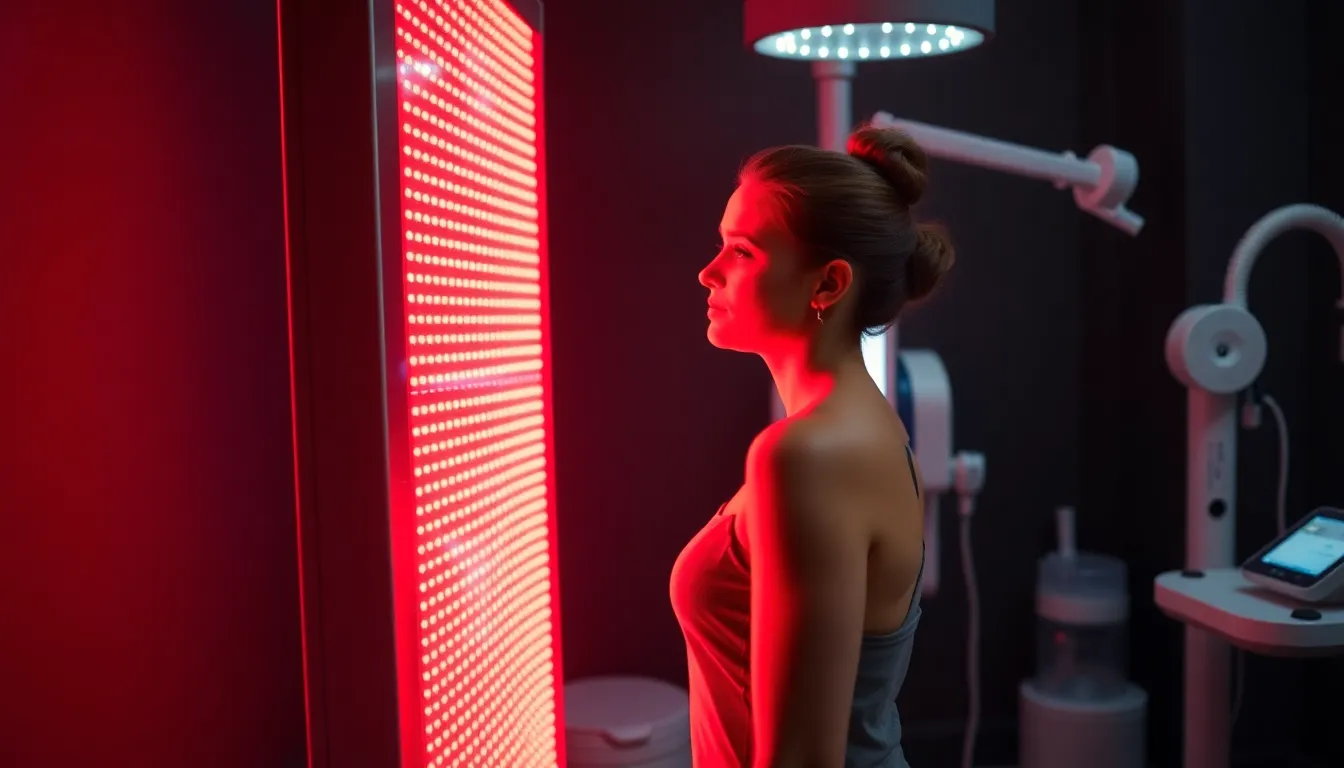
Penny Foskaris is a Functional Nutrition Specialist and red light therapy expert in Anaheim Hills, CA. As the founder of Red Light Pro Devices and a member of the American Academy of Anti-Aging Medicine, she has worked with thousands of clients seeking non-invasive alternatives to surgical and injectable cosmetic procedures.
The face tightening conversation used to have two options: surgery or injections. Facelifts involve anesthesia, incisions, and weeks of recovery. Botox and fillers require repeat appointments every 3 to 6 months, carry risks of migration and allergic reaction, and produce results that look less natural over time.
Red light therapy offers a third option. It is non-invasive, painless, has no downtime, and works by stimulating your body’s own collagen and elastin production rather than injecting foreign materials. The results take longer to appear than a syringe of filler. But they are built from your own biology. And they last.
How Red Light Therapy Tightens Skin Without Surgery
Red light therapy tightens facial skin by stimulating fibroblast activity in the dermis, which increases production of collagen and elastin. These are the two structural proteins responsible for skin firmness, elasticity, and resilience.
Here is what happens at the cellular level during a face tightening session:
Fibroblast activation. Fibroblasts are the cells in your skin responsible for producing collagen and elastin. Red light wavelengths between 630nm and 660nm penetrate the skin and are absorbed by mitochondria in fibroblast cells. This increases ATP production, which gives fibroblasts the energy to produce more structural proteins.
Collagen synthesis increases. New collagen fibers form in the dermis, replacing degraded collagen that has broken down due to aging, sun exposure, and environmental stress. This process is gradual. Visible improvement in skin firmness typically appears within 4 to 6 sessions, with collagen remodeling continuing for months.
Elastin production improves. Elastin is the protein that allows skin to snap back after being stretched. Loss of elastin is why skin sags. Red light stimulates elastin production alongside collagen, restoring some of the bounce and resilience that aging diminishes.
Inflammation decreases. Chronic low-grade inflammation accelerates skin aging. Red light therapy modulates inflammatory cytokines, reducing the inflammation that breaks down collagen faster than the body can replace it.
This is not a one-time effect. Each session compounds on the previous one. The collagen and elastin produced during treatment accumulate over weeks and months, producing progressively firmer, tighter skin.
The Science: Collagen, Elastin, and Cellular Repair
Your body starts losing collagen at approximately 1% per year after age 25. By age 50, you have lost roughly 25% of the collagen you had at your peak. This is why skin thins, sags, and wrinkles with age.
Understanding the biology explains why red light therapy works:
Collagen types. The skin contains primarily Type I and Type III collagen. Type III collagen is the “baby skin” collagen, soft and flexible. As we age, the ratio shifts toward Type I, which is stiffer. Red light therapy has been shown to stimulate both types, improving both firmness and texture.
The dermal matrix. Collagen and elastin form a mesh-like structure in the dermis, the layer of skin below the surface. When this matrix is dense and well-organized, skin looks firm and smooth. When it degrades, skin loses structure and begins to sag. Red light therapy supports the ongoing maintenance and repair of this matrix.
Oxidative stress and aging. Free radical damage from UV exposure, pollution, and metabolic processes breaks down collagen faster than the body can replace it. Red light therapy increases antioxidant enzyme activity within skin cells, providing a layer of protection against oxidative damage.
Blood flow and nutrient delivery. Near-infrared wavelengths (850nm) penetrate deeper than visible red light and stimulate nitric oxide release, which improves blood flow to the skin. Better blood flow means more oxygen and nutrients delivered to fibroblasts, supporting their ability to produce collagen and elastin.
As a member of the American Academy of Anti-Aging Medicine, I follow the peer-reviewed literature on photobiomodulation and skin health. The evidence base for red light therapy’s effect on collagen production is well-established and continues to grow.
What Results Look Like (With Photos)
Results from red light face tightening are gradual, cumulative, and natural-looking. You will not walk out of a single session looking dramatically different. But over 4 to 8 weeks, the changes become visible.
What clients typically notice:
- Weeks 1 to 2. Improved skin tone and a “glow” effect from increased blood flow. Skin looks healthier and more hydrated.
- Weeks 3 to 4. Early tightening visible around the jawline and cheekbones. Fine lines begin to soften.
- Weeks 5 to 8. Noticeable improvement in skin firmness. Nasolabial folds (lines from nose to mouth) appear less deep. Under-eye area looks tighter and less puffy.
- Months 3 to 6. Collagen remodeling continues even after the treatment series ends. Many clients report their best results at the 3-month mark after completing a series.
Our before-and-after gallery includes facial treatment results. The photographs are taken in consistent lighting to document actual changes, not the effect of different angles or filters.
The results are real. But they require consistency. One session will not tighten your face. A structured series of treatments, combined with maintenance, will.
Face Trauma Recovery: A 28-Day Case Study
One of the most dramatic applications of red light therapy for facial recovery involved a client whose face sustained significant trauma.
Over a 28-day protocol of targeted red light therapy sessions, the recovery was documented with photographs at regular intervals. The rate of healing exceeded what was expected based on the nature and severity of the injury.
Red light therapy accelerated the healing process through multiple mechanisms: increased ATP production in damaged tissue, reduced inflammatory response, enhanced blood flow to the treatment area, and stimulated collagen production for tissue repair.
This case is documented in our facial recovery case study. It represents an extreme example of what photobiomodulation can do for facial tissue, but it illustrates the same biological processes that drive cosmetic face tightening: collagen production, inflammation reduction, and cellular repair.
What to Expect During a Face Tightening Session
A face tightening session at Foskaris Wellness takes 15 minutes, uses a dedicated face dome device, and requires zero preparation or recovery time.
Here is what a session looks like:
-
Consultation (first visit only). We discuss your goals: general tightening, fine line reduction, jawline definition, under-eye improvement, or post-procedure recovery support. This determines the protocol: wavelength mix, distance, and session frequency.
-
Positioning. You recline comfortably. The face dome is positioned over your face at the appropriate distance. Eye protection is provided, though the wavelengths used are not harmful to eyes at therapeutic distances.
-
The session. The dome delivers red and near-infrared light to your entire face simultaneously. Sessions last 15 minutes. There is no heat, no discomfort, and no sensation beyond a mild warmth. Most clients find it relaxing.
-
After the session. There is nothing to do. No redness, no peeling, no restrictions. You can apply makeup, go back to work, or continue your day immediately.
For best results, the recommended protocol is 2 to 3 sessions per week for 6 to 8 weeks. After the initial series, maintenance sessions once or twice per month sustain collagen production.
At-Home vs. In-Office Face Treatments
In-office treatments at Foskaris Wellness use clinical-grade equipment with higher LED density and controlled protocols. Home devices extend results between visits.
The face dome available through Red Light Pro Devices brings the same wavelengths to your home. It is designed for daily or every-other-day use and covers the full face in a single application.
Here is how they compare:
In-office advantages:
- Higher LED count and output for deeper penetration
- Controlled environment: consistent distance, timing, and wavelength balance
- Professional protocol management: we adjust based on your progress
- Accountability: scheduled sessions keep you on track
Home device advantages:
- Daily use between office visits accelerates results
- Convenience: use while reading, watching television, or relaxing
- Long-term maintenance after completing an in-office series
- Cost-effective over time compared to repeated in-office visits
The best approach combines both. Complete an in-office series to build the collagen foundation, then maintain with home treatments. This is the protocol I recommend to most face tightening clients.
If you are considering non-invasive face tightening and want to see what red light therapy can do, schedule a consultation at Foskaris Wellness. Call or text (714) 340-0038. You can also read the complete guide to red light therapy for a broader overview of the technology and its applications.